



April 28, 2024


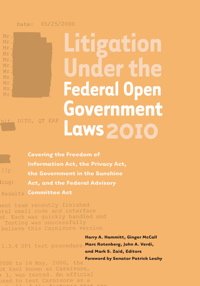
Litigation Under the Federal Open Government Laws
Order Online!














Current News:
January 21, 2009
Obama Issues FOIA Memo on First Day in Office
On his first full day in office, President Barack Obama has issued a memo to the heads of executive departments on the Freedom of Information. Stressing the importance of transparency and accountability, the memo indicates that "the Freedom of Information Act should be administered with a clear presumption: In the face of doubt, openness prevails The Government should not keep information confidential merely because public officials might be embarrassed by disclosure, because errors and failures might be revealed, or because of speculative or abstract fears." The memo adds that "the presumption of disclosure should be applied to all decisions involving FOIA." The memo instructs the Attorney General to issue new FOIA guidance and directs OMB to update its guidance to agencies "to increase and improve information dissemination to the public. . ."
November 27, 2008
Public Interest Groups Offer Recommendations on Access to Obama Administration
Several coalitions of public interest groups and concerned citizens have published recommendations for improving access to information for the incoming Obama administration. The Right to Know Community, coordinated by OMB Watch, released "Moving Toward a 21st Century Right-to-Know Agenda," while the Sunshine in Government Initiative, representing a number of media groups, also published recommendations. The National Security Archive, joined by many other public interest organizations, made recommendations as well. All of them stressed undoing the damage caused by such policies as the Ashcroft memo on FOIA and the Bush executive order on presidential records. Other recommendations included review of over-classification problems, the misuse of non-classified categories such as "sensitive but unclassified" and "controlled unclassified information," and the expanded interpretation and use of various privileges, particularly the state secrets privilege, which the Bush administration has used aggressively to shut down litigation alleging government misconduct. (See, Access Reports, Nov. 12, 2008, p. 1.)
November 27, 2008
Court Criticizes CIA's Misbehavior on Fee Status of National Security Archive
U.S. District Court Judge Gladys Kessler has ruled that the CIA misled the court when it indicated that it was granting news media status to the National Security Archive for purposes of fees. Ordering the agency to grant the news media status on a regular basis, Kessler noted that the agency "has twice made highly misleading representations to the Archive, as well as to this Court. Such extraordinary misbehavior can no longer insulate it from accountability. Since the Defendants' past actions strongly suggest that their misconduct will recur, the CIA's promises to voluntarily halt its misbehavior no longer moot the issue." (National Security Archive v. CIA, Civil Action No. 06-1080, U.S. District Court for the District of Columbia, Nov. 4)
January 1, 2008
Bush Signs FOIA Amendments
President George W. Bush signed into law the OPEN Government Act Dec. 31, marking the first time the FOIA has been amended in ten years. The new amendments restore the attorney's fees eligibility criteria that existed before the Supreme Court's Buckhannon ruling and prohibit agencies from collecting fees if they do not respond to a request within the statutory 20-day time limit. The amendments also provide a tracking system for requests and codify the positions of Chief FOIA Officer and FOIA Public Liaisons that first appeared in the Bush executive order issued in December 2005. The amendments create an ombudsman, designed to resolve disputes short of litigation, at the National Archives and clarify the status of media requesters. Finally, the amendments direct OPM to study how to encourage federal employees to choose FOIA as a career path by creating greater incentives and recognition.
December 20, 2007
New York Court of Appeals Rejects Reporters Committee Rationale
The New York Court of Appeals has rejected the U.S. Supreme Court's Reporters Committee rationale in finding that Suffolk County failed to show why disclosure of an electronic compilation of property records was an unwarranted invasion of personal privacy. The high court ruled that both the trial court and appellate courts improperly shifted the burden of proof to commercial vendor Data Tree to show why Suffolk County had acted improperly. The Court of Appeals also ruled that Data Tree's motive for requesting the records was irrelevant to a determination of whether or not the records were exempt. The court also rejected the County's claim that furnishing an electronic version of the records would require it to create a new record. The court pointed out that "a simple manipulation of the computer necessary to transfer existing records should not, if it does not involve significant time or expense, be treated as creation of a new record." (Data Tree, LLC v. Edward P. Romaine, No. 173, New York Court of Appeals, Dec. 18)
December 19, 2007
Congress Passes FOIA Amendments
The House passed a revised set of FOIA amendments Dec. 18 shortly after the Senate had acted as well. Although the House passed its set of amendments in March and the Senate passed a compromise bill in August, House "pay-as-you-go" rules required that body to revise the Senate bill to provide alternative funding for two provisions -- the potential increase in attorney's fees due to rejection of the Supreme Court's Buckhannon decision as the threhold standard for awarding fees, and to replace the loss of fees agencies would no longer be able to charge if they did not respond within the 20-day statutory time limit. The amendments passed the Senate by unanimous consent and the House by a voice vote. It seems likely that President Bush will sign the legislation or allow the bill to become law by failing to sign or veto it before the upcoming congressional recess.
Editor/Publisher:
Harry A. Hammitt
1624 Dogwood Lane
Lynchburg, VA 24503
Phone: (434) 384-5334